Data Privacy & Protection
Find sensitive data. Classify it. Score the exposure.
Observeri Data Privacy & Protection delivers PII detection and classification, sensitive data discovery, secret and credential scanning, NER-based identification, data exposure scoring, and unified classification across every connected source—so privacy teams know what data exists, where it lives, and how exposed it is.
ROPA
Processing register
Live
Data flow maps
360°
Source coverage
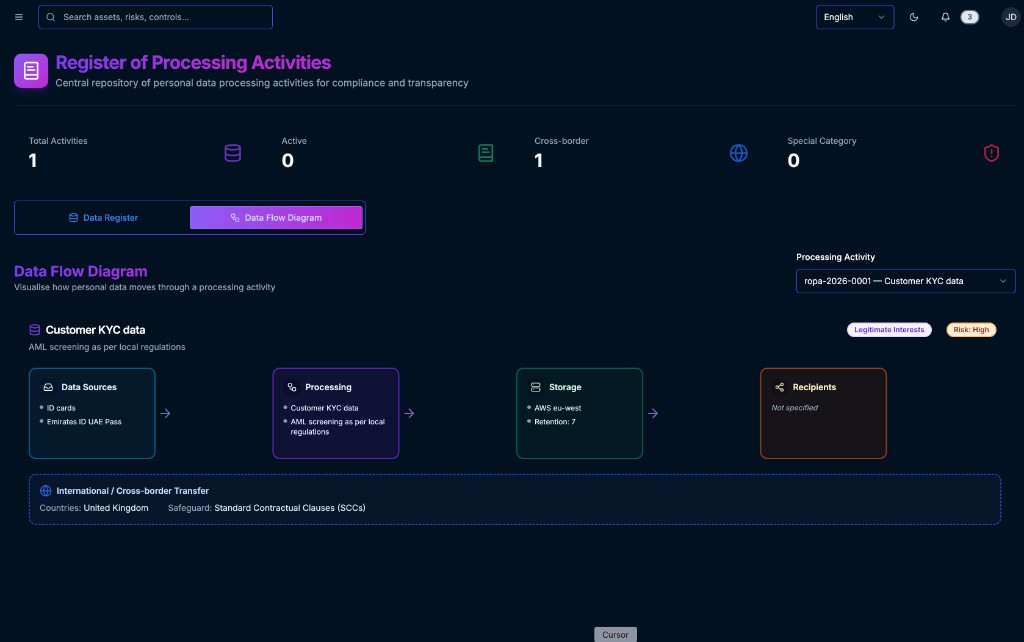
Register of Processing Activities
Register of Processing Activities
Central repository of personal data processing activities for compliance and transparency—switch between a structured data register and interactive data flow diagrams for every processing activity.
Total Activities
Active
Cross-border
Special Category
Data Sources
- • ID cards
- • Emirates ID / UAE Pass
Processing
- • Customer KYC data
- • AML screening per local regulations
Storage
- • AWS eu-west
- • Retention: 7 years
Recipients
- • Documented third-party recipients
- • Transfer safeguards tracked
International / Cross-border Transfer
Countries: United Kingdom
Safeguard: Standard Contractual Clauses (SCCs)
Why it matters
You cannot protect data you cannot see
PII is scattered and unclassified
Personal data sits in databases, file shares, SaaS apps, and code repos—with no consistent classification or ownership map for privacy teams to act on.
Secrets leak into the wrong places
API keys, credentials, and tokens end up in repositories, configs, and logs—creating breach paths that traditional DLP misses until it is too late.
Discovery tools lack context
Regex-based scanners generate false positives and miss contextual sensitive data that named-entity recognition and semantic analysis would catch.
Exposure has no score
Teams know data exists somewhere but cannot quantify how exposed it is—by location, access level, encryption status, or regulatory sensitivity.
What it is
Continuous data privacy intelligence across your estate
Data Privacy & Protection is Observeri's module for discovering, classifying, and scoring sensitive data across connected sources. From PII and credentials to regulated data types identified through NER, every finding feeds a data exposure score that prioritizes remediation and supports GDPR, PDPL, HIPAA, and other privacy programmes.
PII Detection & Classification
Automatically detect personally identifiable information—names, emails, national IDs, phone numbers, and addresses—and assign privacy classification labels aligned to your data taxonomy and regulatory obligations.
Sensitive Data Discovery
Scan connected databases, file stores, cloud buckets, and applications for sensitive data patterns—health records, financial data, biometrics, and custom sensitive categories defined by your organization.
Secret & Credential Scanning
Find exposed API keys, passwords, tokens, certificates, and connection strings across repositories, configs, and logs—before adversaries or researchers discover them first.
NER-Based Identification
Named Entity Recognition models identify contextual sensitive data that pattern matching misses—person names in unstructured text, organization references, locations, and domain-specific entity types.
Data Exposure Scoring
Calculate a data exposure score for every finding based on sensitivity, location, access controls, encryption status, and business context—prioritizing remediation by actual privacy risk.
Cross-Source Classification
Apply consistent data classification labels across all connected sources—unifying taxonomy, ownership, and retention rules whether data lives in cloud, on-prem, or SaaS environments.
Register of Processing Activities
Maintain a central ROPA with data register and interactive flow diagrams—mapping sources, processing, storage, recipients, and cross-border transfers with risk scoring per activity.
Discover everywhere
Classify with AI
Score the exposure
How it works
Connect. Discover. Classify. Score. Act.
A continuous privacy intelligence loop—from source connection through NER-powered discovery to exposure-scored remediation.
Step 1
Connect
Link data sources across your estate
Connect databases, cloud storage, file shares, SaaS applications, code repositories, and collaboration platforms. Observeri inventories data stores and establishes continuous scanning coverage across your connected source landscape.
Activities
Platform features
Six capabilities. One privacy intelligence programme.
Automated PII detection
Detect and classify PII across structured and unstructured data using pattern libraries and AI—covering global identity formats, contact data, and financial identifiers.
Deep sensitive data scanning
Go beyond PII to discover health records, payment data, biometrics, and organization-defined sensitive categories across every connected source.
Secret and credential discovery
Scan repositories, configs, logs, and collaboration tools for exposed secrets—API keys, passwords, tokens, and certificates—with severity scoring and owner routing.
NER-powered entity recognition
Named Entity Recognition identifies people, organizations, locations, and custom entities in free text—reducing false negatives that regex-only tools miss.
Live data exposure scores
Every classified finding receives a continuously updated exposure score reflecting access, encryption, location, and regulatory sensitivity.
ROPA & data flow diagrams
Build and maintain a Register of Processing Activities with visual data flow maps—from sources through processing and storage to recipients and cross-border transfer safeguards.
Benefits for your organization
Privacy protection grounded in discovery, not assumptions
Privacy compliance you can demonstrate
Discovery, classification, and exposure evidence support GDPR, PDPL, HIPAA, and UAE data protection programmes—with audit-ready records of what data exists and how it is protected.
Stop secrets before they become breaches
Continuous credential and secret scanning catches exposed keys and tokens in code and configs—closing a common breach vector before external discovery.
Prioritize by exposure, not volume
Data exposure scoring focuses remediation on the highest-risk findings—restricted data in open buckets, unencrypted PII, and credentials in public repos—not every low-sensitivity match.
One classification model across all sources
Cross-source classification eliminates taxonomy drift between cloud, on-prem, and SaaS—giving privacy and security teams a single data map they can govern.
Faster data subject and breach response
When privacy incidents occur, teams already know where PII lives, how it is classified, and who owns it—compressing investigation and notification timelines.
Reduced regulatory and audit friction
Continuous discovery and classification produce the data inventory regulators expect—replacing manual spreadsheets assembled before each audit cycle.
Measurable reduction in data exposure
Exposure scores track improvement as teams mask, relocate, and restrict sensitive data—giving leadership quantified proof of privacy programme progress.
Platform capabilities
Enterprise data privacy & protection
- PII detection and automated classification across structured and unstructured data
- Sensitive data discovery scanning for databases, file stores, cloud buckets, and SaaS apps
- Secret and credential scanning across code repositories, configs, logs, and collaboration tools
- NER-based data identification for contextual entities in free text and documents
- Data exposure scoring based on sensitivity, access, encryption, and regulatory context
- Register of Processing Activities (ROPA) with data register and interactive flow diagrams
- Cross-border transfer tracking with safeguard documentation (e.g. SCCs)
- Custom sensitive data category definitions aligned to organizational policy
- Regulatory data type mapping for GDPR, PDPL, HIPAA, and regional privacy frameworks
- Continuous rescanning with change detection when new sensitive data appears
- Remediation routing for high-exposure findings with evidence-based closure
- Integration with Exposure Management and AI Risk Operations Center for enterprise risk context
- Privacy audit dashboards showing discovery coverage, classification status, and exposure trends
Quantified outcomes
7
Privacy capabilities
NER
AI entity recognition
100%
Source classification
24/7
Continuous scanning
Regulatory alignment
Data Privacy & Protection supports GDPR, UAE PDPL, HIPAA, and regional data protection frameworks— connecting discovery and classification evidence to Compliance Management and Exposure Management for end-to-end privacy programme governance.
Know your data. Classify it. Reduce the exposure.
PII detection, NER-powered identification, secret scanning, and data exposure scoring across every connected source—built for privacy teams that need proof, not promises.