Human Risk Management
Quantify people risk—AI scans privileged IDs before attackers do
Observeri Human Risk Management continuously profiles identities, monitors high-risk privileged accounts, and calculates Human Risk Exposure (HRE) scores using asset risk, privilege impact, access probability, trust factors, and environmental risk—so teams act on the users driving the greatest cyber exposure.
24/7
Privileged ID scanning
HRE
Risk quantification
$M
Financial exposure
Human Cyber Risk Model
Human Risk Exposure—quantified, visualized, actionable
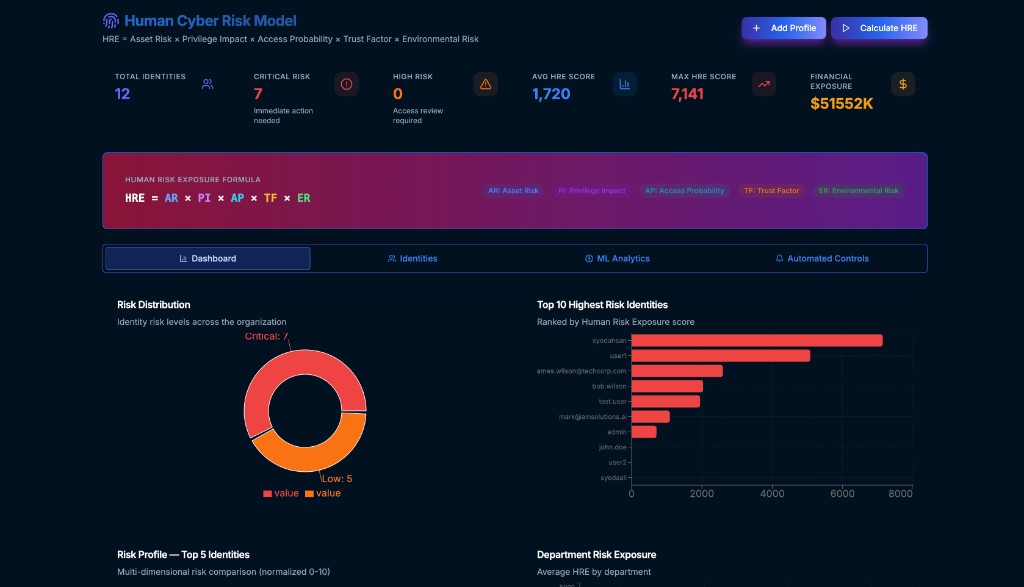
The HRE dashboard combines the Human Cyber Risk Model formula with live identity metrics—showing critical and high-risk counts, average and maximum HRE scores, financial exposure, and the identities requiring immediate action.
HRE = Asset Risk × Privilege Impact × Access Probability × Trust Factor × Environmental Risk
12
Total Identities
7
Critical Risk
0
High Risk
1,720
Avg HRE Score
7,141
Max HRE Score
$51,552K
Financial Exposure
Top highest-risk identities
Why it matters
People are the largest attack surface—and the least measured
Privileged accounts go unchecked
Admin, service, and elevated-access identities accumulate across systems without continuous monitoring—creating blind spots attackers exploit through credential theft and privilege escalation.
User risk is subjective, not scored
Access reviews treat every identity equally instead of prioritizing the privileged users whose compromise would cause the greatest business impact.
Insider signals are buried in logs
Behavioral anomalies, trust degradation, and environmental risk factors sit in disconnected IAM and SIEM tools—with no unified human risk score teams can act on.
Leadership can't quantify people risk
Boards ask for financial exposure from human cyber risk, but teams deliver narrative assessments instead of quantified HRE scores tied to business impact.
What it is
The Human Cyber Risk Model—AI-powered identity exposure intelligence
Human Risk Management applies Observeri's Human Risk Exposure (HRE) formula—Asset Risk × Privilege Impact × Access Probability × Trust Factor × Environmental Risk—to every identity in your organization. AI continuously scans privileged IDs, recalculates scores as posture changes, and triggers automated controls when exposure exceeds thresholds.
Identity Profiling
Build rich identity profiles with department, role, privilege level, asset access, authentication patterns, and device posture—forming the foundation for accurate HRE calculation.
Privileged ID Monitoring
AI continuously scans admin, service, and elevated-access accounts—detecting stale privileges, excessive permissions, dormant admins, and accounts with anomalous access patterns.
HRE Scoring Engine
Calculate Human Risk Exposure using Asset Risk (AR), Privilege Impact (PI), Access Probability (AP), Trust Factor (TF), and Environmental Risk (ER)—producing a quantified score per identity.
ML Analytics Dashboard
Risk distribution charts, top-10 highest-risk identity rankings, department exposure heatmaps, and multi-dimensional risk profile comparisons powered by machine learning.
Automated Controls
When HRE scores exceed defined thresholds, trigger automated access reviews, privilege reduction, MFA enforcement, security awareness training, or account suspension workflows.
Financial Exposure Quantification
Translate human cyber risk into financial exposure dollars—giving boards and executives a business-language view of people-driven cyber risk alongside operational metrics.
Scan privileged IDs
Score with HRE formula
Act with automation
How it works
Profile. Scan. Score. Analyze. Act.
A continuous human risk loop—from identity profiling and AI privileged ID scanning through HRE scoring, ML analytics, and automated control triggers.
Step 1
Profile
Ingest and enrich identity context
Connect identity sources—Active Directory, Okta, Azure AD, HR systems, and IAM platforms—to build living identity profiles with role, department, privilege level, and asset access context.
Activities
Use cases
Where Human Risk Management delivers value
From privileged access reviews to board reporting—six scenarios where continuous HRE scoring and AI privileged ID scanning change how teams manage people risk.
Privileged access review prioritization
Security teams rank access reviews by HRE score instead of reviewing every identity equally—focusing effort on the 7 critical-risk privileged accounts that drive the most exposure.
Insider threat early warning
ML analytics detect trust factor degradation and environmental risk spikes on privileged IDs—surfacing potential insider threats before data exfiltration or sabotage occurs.
Board-ready financial exposure reporting
Translate human cyber risk into dollar-denominated financial exposure—giving CISOs and boards a quantified people-risk metric alongside technical vulnerability and compliance scores.
Automated privilege reduction
When HRE scores breach critical thresholds on dormant or over-privileged accounts, automated controls trigger access reviews or privilege reduction—closing gaps without manual ticket creation.
Department risk benchmarking
Compare average HRE scores across departments—identifying business units with elevated people risk due to excessive admin access, weak MFA adoption, or high environmental risk factors.
M&A identity risk assessment
During mergers and acquisitions, rapidly profile incoming identities, scan privileged accounts, and quantify human risk exposure before integrating IAM environments.
Platform features
Six sub-modules. One human risk programme.
Continuous privileged ID scanning
AI never sleeps—continuously monitoring admin, service, and elevated-access accounts for stale privileges, dormant access, and anomalous behavior patterns.
HRE scoring engine
Five-factor Human Risk Exposure formula combines asset context, privilege level, access probability, trust indicators, and environmental risk into one actionable score.
ML-powered analytics
Risk distribution, top-N identity rankings, department heatmaps, and multi-dimensional risk profile comparisons powered by machine learning models.
Automated control triggers
Threshold-based automation launches access reviews, MFA enforcement, privilege reduction, or security training when identity exposure exceeds defined limits.
Financial exposure quantification
Convert human cyber risk scores into dollar-denominated financial exposure—bridging the gap between technical identity metrics and business language.
AI Risk Operations Center integration
HRE scores feed into the AI Risk Operations Center—correlating people risk with asset exposure, vulnerabilities, and compliance gaps for unified enterprise risk intelligence.
Benefits for your organization
Measure people risk like you measure technical risk
Focus on the privileged few
Instead of reviewing thousands of identities equally, teams concentrate on the critical-risk privileged accounts that would cause the greatest damage if compromised.
Quantified people risk
HRE scores replace subjective assessments with a repeatable, defensible formula—giving auditors, regulators, and boards a consistent metric for human cyber exposure.
Proactive, not reactive
Continuous AI scanning detects privilege drift, dormant admins, and trust degradation before incidents occur—shifting identity security from periodic reviews to always-on monitoring.
Automated risk reduction
Automated controls close exposure gaps immediately when thresholds breach—reducing mean time to remediate for high-risk identities without waiting for manual triage.
Faster privileged access reviews
HRE-ranked identity lists cut access review cycles from months to weeks—by focusing reviewers on the accounts that matter most.
Board-level people risk visibility
Financial exposure metrics and department heatmaps give leadership a clear, quantified view of human cyber risk alongside technical and compliance posture.
Reduced insider and credential risk
Continuous scanning and automated controls shrink the window of exposure for over-privileged, dormant, and anomalous identities across the enterprise.
Platform capabilities
Enterprise human risk management, end to end
- Identity profiling with role, department, privilege level, and asset access context
- AI continuous scanning of high-risk privileged IDs—admin, service, and elevated-access accounts
- Human Risk Exposure (HRE) scoring: Asset Risk × Privilege Impact × Access Probability × Trust Factor × Environmental Risk
- Risk tier classification—Critical, High, Medium, Low—with threshold-based alerting
- ML analytics dashboard with risk distribution, top-N rankings, and department exposure heatmaps
- Multi-dimensional risk profile comparison (radar charts) for top identities
- Automated control triggers—access reviews, privilege reduction, MFA enforcement, training assignment
- Financial exposure quantification in dollar-denominated people-risk metrics
- Identity source connectors—Active Directory, Okta, Azure AD, HR systems, IAM platforms
- Anomaly detection for unusual authentication, access patterns, and data movement
- Integration with AI Risk Operations Center, Information Asset Management, and Security Governance
- Audit-ready evidence trails for access reviews, control triggers, and HRE score history
Quantified outcomes
24/7
Privileged ID scanning
5-factor
HRE formula
Auto
Control triggers
$M
Financial exposure
Connected to Observeri GRC
Human Risk Management feeds HRE scores into the AI Risk Operations Center—integrating with Information Asset Management, Security Governance, and Data Privacy & Protection so people risk stays synchronized with asset exposure and compliance posture.
From privileged ID scanning to quantified human risk
Profile identities, scan privileged accounts with AI, score HRE, analyze with ML, and trigger automated controls—all in one module.